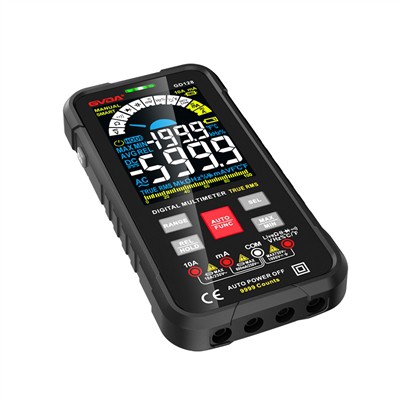
Human reading error is one of the reasons that affect the measurement accuracy. It is unavoidable but can be minimized. Therefore, special attention should be paid to the following points during use: 1. Before measuring, place the multimeter horizontally and perform mechanical zero adjustment; 2. When reading, the eyes should be kept perpendicular to the pointer; When the adjustment is less than zero, replace with a new battery; 4. When measuring resistance or high voltage, do not pinch the metal part of the test lead with your hands, so as to avoid shunting of human body resistance, increase measurement error or electric shock; Cut off the power supply in the circuit, and discharge the electricity stored in the capacitor before measuring. After excluding the human-made reading errors, we conduct some analysis on other errors.
Each range of electrical resistance can measure the resistance value from 0 to ∞. The scale scale of an ohmmeter is a non-linear, uneven, inverted scale. It is expressed as a percentage of the arc length of the scale. Moreover, the internal resistance of each range is equal to the multiplier of the central scale number of the arc length of the scale, which is called "central resistance". That is to say, when the measured resistance is equal to the center resistance of the selected range, the current flowing in the circuit is half of the full scale current. The pointer indicates the center of the scale. Its accuracy is expressed by the following formula:
R percent =(△R/center resistance)×100 percent ……2
(1) When using a multimeter to measure the same resistance, the error caused by selecting different ranges
For example: MF{{0}} multimeter, the central resistance of the Rxl0 block is 250Ω; the central resistance of the Rxl00 block is 2.5kΩ. The accuracy level is 2.5. Use it to measure a 500Ω standard resistance, and ask whether to use R×l0 gear or R×100 gear to measure, which error is larger? Solution: From formula 2:
The maximum allowable error of R×l0 block △R(10)=central resistance×R percent =250Ω×(±2.5) percent =±6.25Ω. Use it to measure 500Ω standard resistance, then the indicated value of 500Ω standard resistance is between 493.75Ω-506.25Ω. The maximum relative error is: ±6.25÷500Ω×100 percent =±1.25 percent .
The maximum allowable error of R×l00 block △R(100)=central resistance×R percent 2.5kΩ×(±2.5) percent =±62.5Ω. Use it to measure 500Ω standard resistance, then the indicated value of 500Ω standard resistance is between 437.5Ω-562.5Ω. The maximum relative error is: ±62.5÷500Ω×100 percent =±10.5 percent .